Decarbonization at the Erfurter Kreuz: Companies Focus on Collaborative Solutions for a Resilient Industry

Workshop of the DekaRB research project brings together business, academia, and industry partners
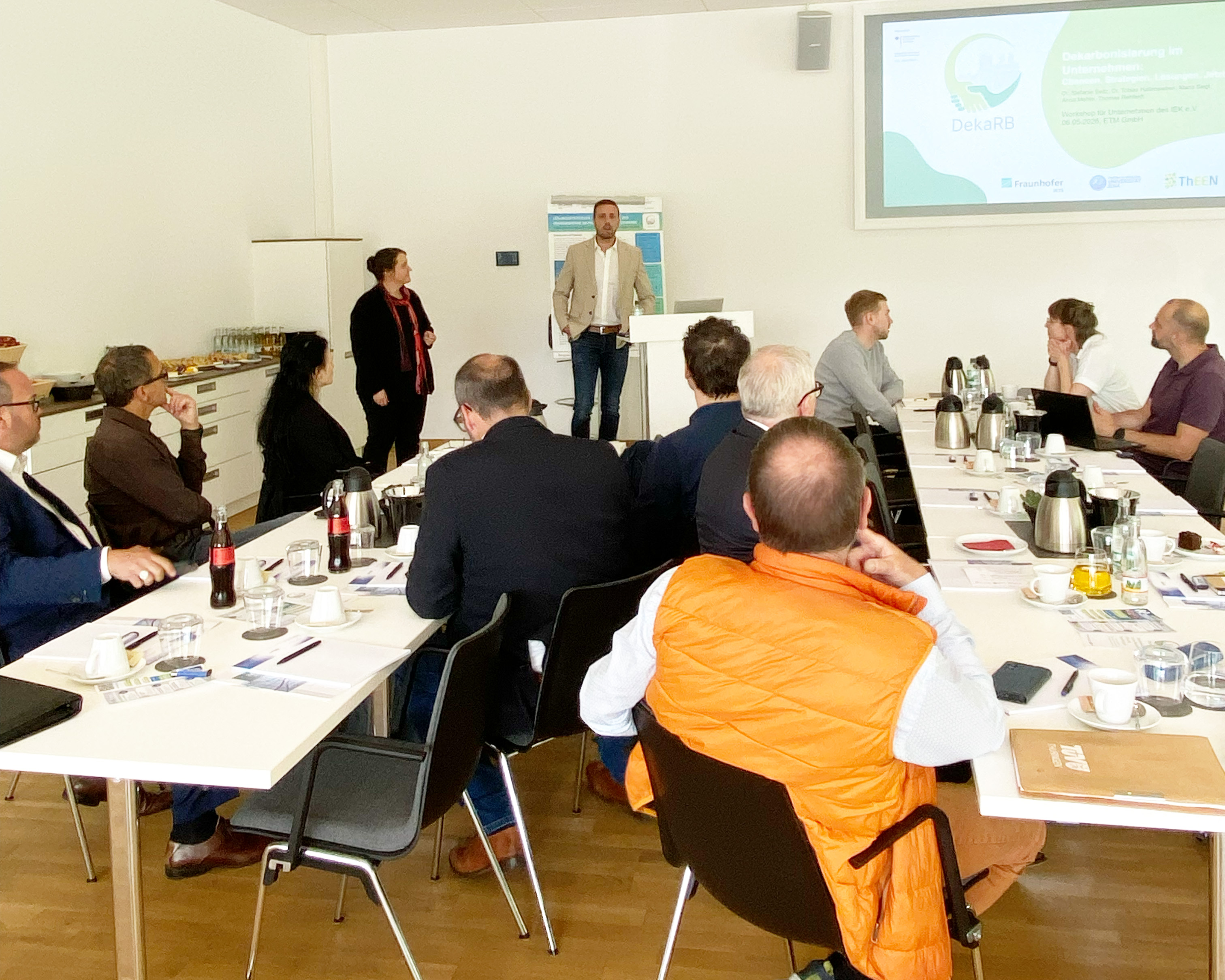
On May 6, 2026, industry representatives, together with researchers, energy experts, and other guests, gathered at ETM GmbH in Arnstadt to discuss practical pathways toward a climate-friendly transformation of industry. The two-hour workshop “Decarbonization in Business: Opportunities. Strategies. Solutions. Now.” impressively demonstrated that many companies want to actively shape the transition – but need reliable framework conditions, regional cooperation, and practical support services to do so. The workshop was organized by the consortium of the BMWE-funded DekaRB research project [Link] under the patronage of the Initiative Erfurter Kreuz (IEK) e.V.

Decarbonization as a competitive factor

The event focused not only on the challenges of the energy transition but, above all, on practical solutions for companies in the manufacturing sector. Since September 2024, the DekaRB project has been investigating, over a three-year period, which non-technical factors hinder transformation processes – including uncertainty in investment decisions, a lack of coordination, or insufficient acceptance.

Dr. Stefanie Seitz from Fraunhofer IKTS presented the goals of the collaborative project and emphasized the importance of regional cooperation for a successful industrial transformation. To this end, the project is working closely with three industrial clusters in Thuringia – the Erfurter Kreuz Initiative, the Tridelta Campus Hermsdorf, and Saalewirtschaft e.V.—and is pursuing a collaborative approach: Together with industry partners, solutions are developed, prototyped, and tested in the study regions.

Practical example demonstrates the economic potential of the energy transition

The case study presented by Markus Hellmund of MAXX SOLAR & ENERGIE GmbH & Co. KG generated a particularly strong response. The presentation met with extraordinary interest from the audience, as Hellmund openly provided detailed insights into the process of transforming his own company, using concrete metrics. He demonstrated how the company has established a nearly self-sufficient energy supply through on-site photovoltaic power generation, battery storage, heat pump technology, and the integration of electric vehicles – both in its own fleet and in employees’ vehicles.

The presentation made it clear that decarbonization can not only contribute to climate protection but also create significant economic benefits, greater supply security, and long-term resilience for companies. Hellmund further highlighted the economic and social benefits resulting from consistent implementation for the entire company and its workforce.

Study identifies key barriers for companies

Thomas Rehfeldt from Friedrich Schiller University in Jena presented interim results of the DekaRB project’s empirical study. The study is based on over 60 guided interviews conducted to date with companies and external stakeholders from politics, administration, associations, and academia. The study identifies three key challenges:

  • Structural barriers: Economic uncertainty and low risk tolerance, particularly among SMEs, exacerbated by increasing economic pressure and political conditions that encourage a wait-and-see attitude.
  • Bureaucracy and lack of participation: High bureaucratic requirements, a lack of strategic direction, and insufficient communication and transparency in planning processes at the local and corporate levels.
  • Fears and social conflicts: Social uncertainty, doubts about the economic viability of the transformation, as well as polarization and disinformation – exacerbated by social media and populist actors.

In the ensuing discussion, participants strongly confirmed the findings based on their own corporate experience. The study’s findings, which were also published in the DekaRB white paper [Link], largely align with the experiences and impressions of the corporate representatives in attendance. The desire for concrete, regionally anchored support structures was articulated particularly clearly.

Companies want regional cooperation

In the final part of the workshop, Dr. Stefanie Seitz (Fraunhofer IKTS) and Maria Siegl (ThEEN e.V.) presented practical support offers for companies – developed by the DekaRB team in collaboration with its industry partners – as part of “action pitches.” The spectrum included, among other things:

  • Information and training offers (flexible online modules, workshops, and exchange formats),
  • change management guidance and strategic process support,
  • coordination of consortia, project management, and accompanying communication,
  • joint initiatives and thematic working groups for the implementation of specific projects.

Participants prioritized, in particular, local initiatives and practice-oriented working groups in which companies can jointly address specific challenges. In second place were consulting services, particularly for navigating the funding landscape, followed by the provision of specific knowledge – for example, on ways to implement the energy transition.

A key outcome of the event was also the proposal to build on the existing IEK e.V. project initiative “Clean EFX” and develop a joint project to realize a cost-effective and reliable renewable energy supply in the Erfurter Kreuz industrial park.

Combining research and practice

The results of the workshop were subsequently presented at the IEK e.V. general meeting, where they were met with great interest. This allowed the event to be directly leveraged to present the findings to a broader audience and to attract additional companies and partners for joint transformation projects – particularly the Clean EFX initiative.